

Mass Displacement Crisis
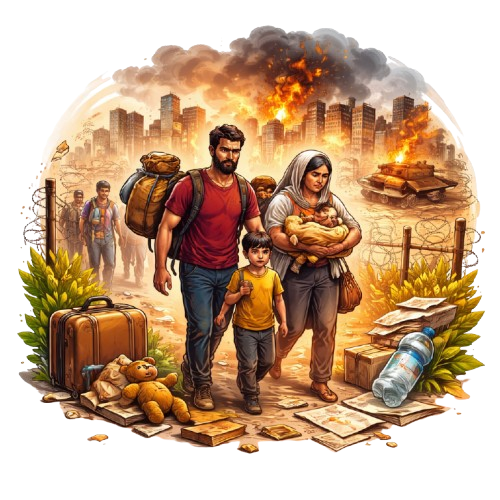
The global displacement crisis has reached unprecedented levels, representing one of the most urgent humanitarian challenges of our time. According to recent global estimates, over 110 million people have been forcibly displaced due to a combination of armed conflict, political instability, natural disasters, and the escalating impacts of climate change. This figure reflects not only the scale of the crisis but also the complexity of its underlying causes and consequences.
🌐 Understanding Displacement
Hunger is not only a humanitarian issue—it is an economic one. Food insecurity reduces productivity, increases healthcare costs, and limits economic growth.
Communities affected by hunger often experience:
Reduced workforce capacity
Increased poverty cycles
Limited educational attainment
At a national level, hunger can hinder development and stability, creating long-term challenges for governments and societies.
⚔️ Conflict as a Primary Driver
Armed conflict remains the leading cause of displacement globally. Prolonged wars, civil unrest, and political instability have forced millions to flee their homes. Regions affected by ongoing conflict experience:
Destruction of infrastructure
Collapse of governance systems
Limited access to basic services
Civilians are often caught in the crossfire, leaving them with no option but to escape. In many cases, displacement becomes long-term, with families spending years—or even decades—in refugee camps or informal settlements.
🌪️ Climate Change and Environmental Displacement
Climate change is emerging as a major driver of displacement, intensifying natural disasters and environmental degradation. Rising sea levels, desertification, extreme weather events, and resource scarcity are forcing communities to relocate.
Unlike conflict-driven displacement, climate-induced displacement often lacks legal recognition, leaving affected populations without adequate protection. This creates a significant gap in international response mechanisms.
Communities in coastal regions, small island nations, and arid zones are particularly vulnerable. As environmental conditions worsen, displacement is expected to increase, making climate migration one of the defining challenges of the 21st century.
🏚️ Loss of Livelihoods and Economic Instability
Displacement is not only about losing a home—it is about losing a way of life. Many displaced individuals depend on agriculture, fishing, or local economies that are disrupted by conflict or environmental changes.
Without access to employment opportunities, displaced populations often face:
Poverty and economic insecurity
Dependency on humanitarian aid
Exploitation and unsafe working conditions
Economic instability further exacerbates vulnerability, making it difficult for individuals to rebuild their lives.
🧒 Impact on Vulnerable Populations
Certain groups are disproportionately affected by displacement, including:
Women and girls, who face increased risks of gender-based violence
Children, who lose access to education and stability
Elderly and disabled individuals, who struggle with mobility and access to care
Displacement disrupts social structures and support systems, leaving vulnerable populations exposed to significant risks.
Children, in particular, are deeply affected. Many are forced out of school, increasing the likelihood of child labor, early marriage, and long-term poverty. The psychological impact of displacement—trauma, stress, and uncertainty—can have lasting effects on their development.
🏕️ Living Conditions in Displacement Settings
Displaced populations often reside in camps, temporary shelters, or informal settlements. While these spaces provide immediate safety, they are frequently characterized by:
Overcrowding
Limited access to clean water and sanitation
Inadequate healthcare services
Poor living conditions
Prolonged displacement can turn temporary solutions into permanent realities, creating cycles of dependency and marginalization.
Urban displacement is also increasing, with many individuals moving to cities in search of opportunities. However, this often leads to the growth of informal settlements and increased pressure on urban infrastructure.
🌍 Challenges for Host Communities
Host communities play a critical role in supporting displaced populations, but they also face challenges. The sudden influx of people can strain:
Public services (healthcare, education, housing)
Employment opportunities
Natural resources
Without adequate support, tensions may arise between displaced populations and host communities. This highlights the need for inclusive approaches that benefit both groups.
⚖️ Legal and Policy Gaps
While international frameworks exist to protect refugees, significant gaps remain—particularly for internally displaced persons and climate migrants. Many displaced individuals lack:
Legal recognition
Access to rights and services
Long-term protection
Strengthening legal frameworks and ensuring their implementation is essential for addressing the displacement crisis effectively.
🤝 The Need for Coordinated Global Action
The scale of displacement requires a coordinated response involving governments, international organizations, NGOs, and local communities. Key priorities include:
Conflict prevention and resolution
Climate adaptation and mitigation
Economic development and livelihood support
Strengthening legal protections
Collaboration is essential to address both the immediate needs of displaced populations and the root causes of displacement.
🌱 Long-Term Solutions
Addressing displacement requires a shift from short-term relief to long-term solutions. These include:
Sustainable reintegration for returning populations
Resettlement programs for refugees
Community-based development initiatives
Investment in resilience and infrastructure
Empowering displaced individuals to rebuild their lives is key to breaking the cycle of displacement.
GJU’s Perspective
At Global Justice for Unity (GJU), we view displacement not only as a humanitarian crisis but as a challenge of justice, equity, and global responsibility. Every displaced individual represents a story of resilience, but also a failure of systems meant to protect them.
Our approach focuses on:
Supporting displaced communities with dignity
Advocating for inclusive policies
Promoting sustainable solutions
Strengthening resilience at the grassroots level
We believe that displacement is not inevitable—it is preventable. By addressing its root causes and fostering global unity, we can create a future where no one is forced to leave their home in search of safety.