

🤝 Insufficient Coordinated Global Action
In an increasingly interconnected world, global challenges such as conflict, hunger, climate change, and biodiversity loss cannot be addressed in isolation. Yet, one of the most critical barriers to progress is the lack of coordinated global action. Despite the presence of international institutions, agreements, and initiatives, fragmented efforts, policy gaps, and limited collaboration continue to slow meaningful progress.
At Global Justice for Unity (GJU), we recognize that without unity, even the most well-intentioned efforts can fall short. Effective solutions require alignment, cooperation, and shared responsibility among governments, organizations, and communities worldwide.
🌐 Understanding the Coordination Gap
Global coordination refers to the alignment of policies, resources, and actions across countries and sectors to address shared challenges. However, in practice, coordination often faces significant obstacles:
Conflicting national interests
Lack of communication between stakeholders
Unequal distribution of resources
Political and economic competition
These challenges create fragmented responses, reducing the overall effectiveness of global initiatives.
⚖️ Fragmentation in Global Governance
International governance structures are designed to facilitate cooperation, but fragmentation remains a major issue. Multiple organizations and agencies often work on similar issues without sufficient alignment, leading to:
Duplication of efforts
Inefficient use of resources
Inconsistent policies and strategies
For example, in humanitarian response, different organizations may operate independently, resulting in gaps in coverage or overlapping services.
🌍 Inequality Between Nations
Global coordination is further complicated by inequalities between developed and developing countries. Wealthier nations often have greater resources and influence, while lower-income countries face limitations in capacity and funding.
This imbalance leads to:
Unequal participation in decision-making
Limited access to resources for vulnerable regions
Disparities in implementation of global agreements
Addressing these inequalities is essential for achieving true global cooperation.
🏛️ Political and Geopolitical Barriers
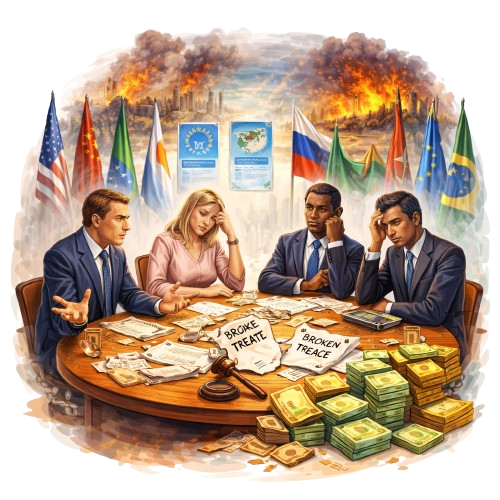
Political dynamics play a significant role in shaping global action. National interests, geopolitical tensions, and policy differences can hinder collaboration.
Key challenges include:
Lack of consensus on global priorities
Short-term political agendas overriding long-term goals
Limited trust between nations
These barriers often delay critical decisions and reduce the effectiveness of international agreements.
🌡️ Climate Action and Policy Gaps
Climate change is a clear example of the need for coordinated global action. While international agreements exist, implementation varies widely across countries.
Challenges include:
Inconsistent commitments to emission reductions
Lack of accountability mechanisms
Insufficient funding for climate adaptation
Without unified action, efforts to mitigate climate change remain fragmented and insufficient.
🍞 Food Security and Resource Distribution
Global food systems also suffer from coordination gaps. While some regions produce surplus food, others face severe shortages.
Issues include:
Inefficient distribution systems
Trade barriers and policy restrictions
Lack of investment in vulnerable regions
Coordinated strategies are needed to ensure equitable access to food and resources.
🏥 Health and Humanitarian Response
The COVID-19 pandemic highlighted the importance of global coordination in health systems. However, it also exposed significant weaknesses, including:
Unequal access to vaccines and healthcare
Delayed response mechanisms
Lack of information sharing
Strengthening global health systems requires improved collaboration and preparedness.
📊 Data, Technology, and Information Sharing
Effective coordination relies on accurate data and information sharing. However, gaps in data collection and transparency can hinder decision-making.
Challenges include:
Limited access to reliable data in some regions
Lack of standardized systems
Barriers to information sharing
Technology has the potential to improve coordination, but it must be accessible and inclusive.
🤝 The Role of Partnerships
Partnerships are essential for bridging coordination gaps. Collaboration between governments, NGOs, private sector entities, and communities can enhance:
Resource mobilization
Knowledge sharing
Innovation
Public-private partnerships, in particular, play a crucial role in addressing complex challenges.
🌱 Local vs Global Approaches
While global coordination is important, local contexts must not be overlooked. Solutions must be adaptable to specific cultural, social, and economic conditions.
Balancing global strategies with local implementation ensures:
Relevance and effectiveness
Community ownership
Sustainable impact
🌟 GJU’s Perspective
At Global Justice for Unity (GJU), we believe that coordination is not just a strategy—it is a necessity. The challenges facing our world are interconnected, and addressing them requires a unified approach.
Our commitment includes:
Building partnerships across sectors and regions
Promoting inclusive and equitable decision-making
Advocating for stronger global frameworks
Encouraging transparency and accountability
We strive to act as a bridge—connecting stakeholders, fostering collaboration, and driving collective action.
🌍 Path Forward: Strengthening Global Unity
To overcome coordination challenges, the global community must focus on:
Strengthening international institutions
Promoting equitable participation
Enhancing transparency and accountability
Investing in shared solutions
Innovation, technology, and collaboration will play key roles in shaping the future of global action.
The lack of coordinated global action is one of the greatest obstacles to solving the world’s most pressing challenges. However, it is also an opportunity—an opportunity to rethink how we work together, to build stronger partnerships, and to create systems that prioritize collective well-being over individual interests.
At Global Justice for Unity, we believe that true progress begins with unity. By aligning efforts, sharing responsibility, and working together across borders, we can overcome even the most complex challenges.